
GoHighLevel starts at $97 a month and puts a CRM, pipelines, workflows, calendars, funnels, and texting behind a single login.
That's the short answer to what GoHighLevel CRM is: one system where a lead gets captured, followed up, booked, and tracked without bouncing between five tools. Most people searching for it are tired. A form tool here, a texting app there, and a spreadsheet nobody fully trusts.
They don't want another dashboard. They want to know whether this one will hold the whole process together. The trouble is that most explainers stop at "all-in-one." They list modules without showing how a lead moves through them, or what the bill looks like once texts and calls are metered. Buy it on that basis, and the risk is an account full of unused features, a pipeline nobody maintains, and leads that still wait hours for a reply.
This guide explains what GoHighLevel CRM is, how a lead moves through it, what each plan costs, and who should skip it.
| Quick Answer: GoHighLevel CRM at a Glance | |
|---|---|
| What it is: | One platform that combines CRM, pipelines, workflows, calendars, forms, funnels, and reputation tools, built by HighLevel Inc. in Dallas. |
| How it works: | A lead enters as a contact, sits in a pipeline stage, and triggers workflows that send texts and emails and book appointments. |
| Pricing: | $97, $297, or $497 a month, about 17% less on annual billing, with unlimited contacts and users on every plan. |
| Sub-accounts: | Starter allows three separate client workspaces. Unlimited and the $497 plan have no cap. |
| Extra costs: | Texts, calls, and email are metered per use on top of the plan fee. |
| Best for: | Agencies and appointment-based service businesses that want one system for lead follow-up. |
| Think twice if: | One business runs one simple pipeline and has nobody to configure the platform. |
What Does GoHighLevel CRM Include, and Which Tools Does It Replace?
GoHighLevel, also called HighLevel or GHL, is a software platform that puts the core jobs of lead handling under one roof.
GoHighLevel CRM bundles lead capture, follow-up, booking, and reporting into one login
The CRM sits at the center. Every form fill, call, text, and booking attaches to a single contact record, so nobody has to ask which tool holds the latest conversation.
Around it sit the tools most businesses rent separately: a website and funnel builder, an online calendar, email and SMS, review requests, invoices, and a workflow builder. The entry plan includes all of them.
It replaces a stack of separate tools, but only if the team actually moves into it
A typical small-business stack looks like a form plugin, an email service, a texting app, a booking page, and a spreadsheet. GoHighLevel can stand in for each one.
The real saving isn't the subscription fees. It's that a lead's history stops living in five places.
Teams that would rather not configure it alone can use Funnel Gator's GoHighLevel CRM setup service, which builds pipelines, calendars, and workflows around how the business sells.
Popular advice says to move everything in week one, and that's the fastest way to break follow-up
During CRM migration, moving every form, phone number, and automation at once leaves no working baseline. If replies slow down, nobody can tell whether the old system or the new one caused it.
A safer order is one lead source first. Confirm the follow-up fires, then move to the next. The platform doesn't mind a phased migration, and leads never notice one.
Ready for a GoHighLevel CRM Built Around How You Sell? Book a Call With Funnel Gator
Funnel Gator maps your lead flow first, then builds the GoHighLevel system around it.
- A pipeline built around your real sales stages
- Workflows for fast follow-up, booking, and reminders
- Reporting that shows where every lead stands
The call maps your lead flow, your system, and your next steps.
▸ Book a call with experts now!
How Does GoHighLevel Work From First Lead to Booked Appointment?
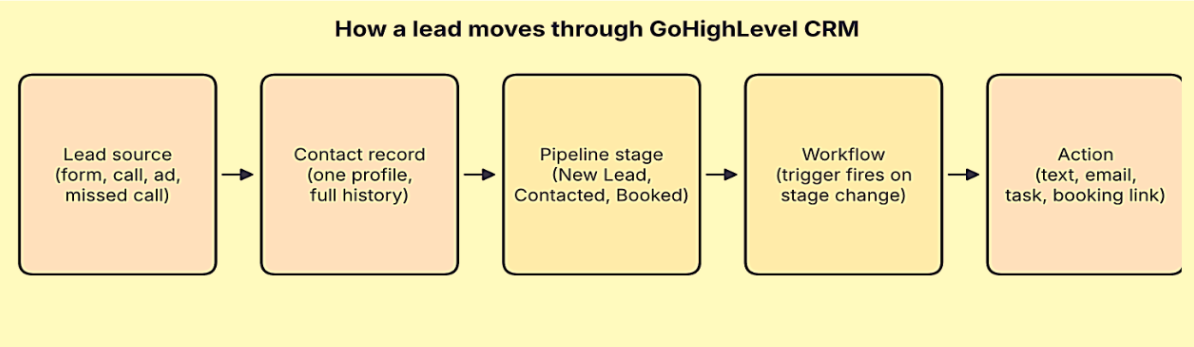
GoHighLevel works as a chain. A lead source creates a contact, the contact lands in a pipeline stage, and each stage change can trigger an automation.
A lead becomes one contact record, and that record moves through pipeline stages
Every plan includes unlimited contacts, so each form fill, call, or text creates or updates a single contact record rather than a new row somewhere else.
That record carries the conversation history, notes, tags, and any open opportunity. The opportunity is the deal itself, sitting in a stage such as New Lead, Contacted, Booked, or Won.
Workflows watch for triggers and run the follow-up without anyone having to remember
CRM automation works on a trigger-and-action model. A trigger might be a form submission, a stage change, or a missed call. The actions can send a text, send an email, create a task, or move the opportunity.
Chain a few together and a new enquiry can get an instant text, a task for the owner, and a booking link within seconds. That's GoHighLevel automation in practice.
Missed-call recovery is a common example. When a call goes unanswered, the workflow sends a text straight away, so the caller isn't left wondering whether anyone will respond.
No-show recovery works the same way. If a booked contact doesn't turn up, the stage change triggers a rebooking message instead of a dead lead.
Tags and smart lists sit alongside this. They group contacts by source, service, or stage, so bulk messages reach the right people rather than the whole database.
Named case: Apex Auto Care's nine connected GoHighLevel pipelines
In our work with Apex Auto Care, we built the customer journey as nine connected GoHighLevel pipelines, covering leads, scheduling, dealers, collisions, and support, with automated follow-up.
Through speed-to-lead automation, response time dropped from hours to 5 minutes. That's the same mechanism described above, applied across a whole service operation.
What Are the Core Modules of GoHighLevel CRM, and Which Ones Do Most Teams Use First?
The platform lists dozens of features, but a handful carry most of the day-to-day work.
Contacts, conversations, and calendars handle the first response
The conversations inbox puts texts, emails, calls, and social messages into one thread per contact. Calendars let leads book themselves into open slots, while appointment reminder automation sends reminders automatically.
GoHighLevel pipelines track every opportunity from first touch to closed deal
GoHighLevel pipelines are the visual board. Each column is a stage, and each card is an opportunity with a value, an owner, and a next step.
How to design stages that actually convert is covered in Funnel Gator's guide to how a CRM pipeline improves lead conversion, so this guide stays on the platform itself.
Funnels, forms, reporting, and reviews feed and measure the pipeline
The website and funnel builder, forms, and surveys capture leads and drop them into the right pipeline. Lead scoring and attribution reporting then show which sources produce real opportunities.
Payments, invoices, and review requests close the loop after the job is done. Conversation AI and Reviews AI are listed among the Starter features too.
Snapshots turn a working setup into a repeatable template
Snapshots are listed on the Starter plan. A snapshot saves a set of pipelines, workflows, and funnels so it can be loaded into another sub-account.
For agencies, that means a client onboarding starts from a tested build instead of a blank account. For a single business, it works as a backup of a setup that already runs well.
How Much Does GoHighLevel Cost, and What Isn't in the Sticker Price?
Three plans exist, and all of them include unlimited contacts and users.
GoHighLevel pricing runs $97, $297, or $497 a month, with about 17% off for annual billing
According to HighLevel's own pricing page (checked November 2026), Starter costs $97 a month and allows up to three sub-accounts. Unlimited costs $297 and removes the cap.
The $497 plan adds SaaS Mode, which lets agencies resell the platform under their own brand. Guides label it Agency Pro, SaaS Pro, or Founder, so check the price, not the name.
The page also lists a 14-day free trial. A sub-account is a separate workspace, usually one per client or location.
| Plan | Price | What changes at this tier |
|---|---|---|
| Starter | $97 a month, or $970 a year | Up to three sub-accounts, plus the core CRM, pipelines, workflows, funnels, and calendars |
| Unlimited | $297 a month, or $2,970 a year | Unlimited sub-accounts, a branded desktop app, and phone and email rebilling without markup |
| $497 plan | $497 a month, or $4,970 a year | SaaS Mode, rebilling with markup, advanced API access, and custom objects |
| Usage fees | Billed per use on every plan | Texts, calls, and email are metered on top of the plan fee |
Annual totals come from a 2026 RevenueGeeks plan breakdown. The saving works out to $194 a year on Starter, $594 on Unlimited, and $994 on the $497 plan.
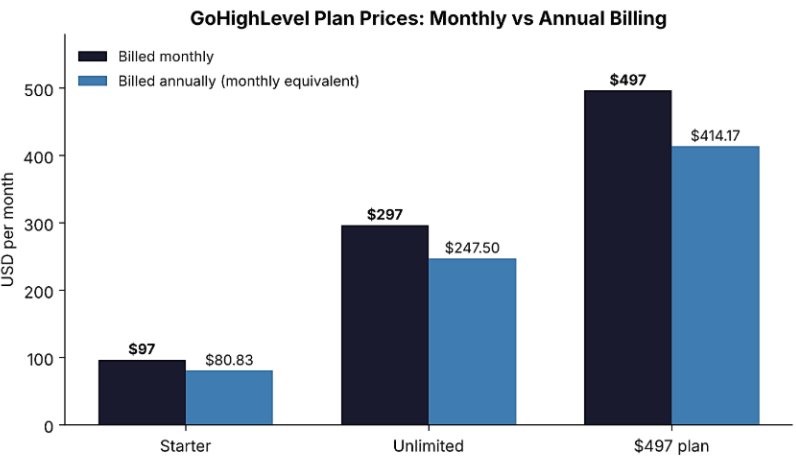
Usage fees sit on top of the plan fee
The plan fee covers the platform, not the messages. A 2026 Apexure pricing breakdown citing HighLevel's help centre puts email at $0.675 per 1,000 sent and adds 5% to every phone charge at sub-account level.
Low message volumes barely show up on the bill. At that email rate, 10,000 emails in a month cost about $6.75. Texting and calling rates are where to look next, and HighLevel's help centre lists them.
The real price depends on whether the account serves one business or many
For agencies, the math is per client. Starter's three sub-accounts work out to about $32 each at $97, and Unlimited spreads $297 across four clients to about $74 each.
A single business uses one sub-account, so the full $97 is the real entry price before messages. That's the number to compare against a standalone CRM, not the agency-friendly per-client figure.
Who Is GoHighLevel CRM Built For, and Who Should Skip It?
The platform's origin explains most of its design, and its design explains who gets value from it.
Agencies and appointment-based service businesses get the most from it
HighLevel was founded in 2018 by Shaun Clark, Varun Vairavan, and Robin Alex, and Dallas Innovates reports it began with a mission to help marketing agencies grow and scale. Sub-accounts and white-labeling still reflect that origin.
Service businesses that live on booked appointments fit the same pattern: lead in, fast reply, booking, follow-up. That includes automotive shops, clinics, and home services.
That's why GoHighLevel for agencies is the use case most guides lead with.
A single business with one simple pipeline should think twice
The pricing is built around agencies billing clients. For a business with one pipeline and one form, the plan fee buys a phone system, a funnel builder, and a course platform it may never open.
The deciding factor isn't company size. It's whether someone will own the configuration.
Agencies and in-house teams use the same platform in different ways
An agency runs many sub-accounts and often rebills phone and email usage to clients. Unlimited allows rebilling without markup, and the $497 plan allows it with markup.
An in-house team runs one account, so rebilling and SaaS Mode don't matter. Its questions are simpler: how many pipelines, how many follow-up workflows, and who maintains them.
Two limits are worth knowing before choosing a tier
Custom objects, which track records beyond contacts such as vehicles or properties, are listed only on the $497 plan. So are advanced API features like OAuth 2.0 and sub-account creation.
Starter and Unlimited include basic API access and a Zapier integration. That's enough for most connections to forms, calendars, and email tools.
This guide doesn't cover SaaS Mode or white-label reselling in depth. Those need their own walkthrough, and the pricing page lists what each tier unlocks.
What Do Teams Get Wrong When Setting Up GoHighLevel CRM?
Most setup problems come from doing too much too early, not from the platform itself.
Switching on every module before the first pipeline works
The platform ships with dozens of tools. Turn them all on at once and there are more places for a lead to stall, and nobody knows which workflow sent which message.
A quick test helps. If one person can't describe a lead's path from first touch to booking in a minute, the setup is too big.
Building pipelines around the template instead of the sales process
Stages should mirror how deals actually move. A template built for a generic business forces real opportunities into columns that don't match what the team does next.
Ask the people who work the leads what they say in conversation. The stages they already use out loud are usually the right ones.
Treating automated texting as free and unregulated
Bulk follow-up costs money per message, and texting at scale brings carrier registration and consent rules. Compliance setup belongs before the first campaign, not after.
Opt-in wording, quiet hours, and unsubscribe handling belong in the workflow design from the start. Adding them later means rewriting messages that are already live.
Final Verdict: Start With One Pipeline
GoHighLevel CRM earns its price when someone will own the setup and the business lives on fast follow-up. Build one pipeline, one calendar, and one workflow first, then add modules only when each earns its place.
This fits agencies and appointment-based service businesses that lose revenue when a lead waits hours for a reply. Once the first loop runs, every enquiry has a next step, a visible stage, and an owner.
A single business with one simple pipeline and nobody to configure the platform should skip it. To have the system built around your sales process, talk to Funnel Gator.
FAQs About GoHighLevel CRM
Does GoHighLevel pricing include a free plan?
No, GoHighLevel has no permanent free plan, only a 14-day free trial. Paid plans start at $97 a month with unlimited contacts and users.
Is GoHighLevel CRM a real CRM or only marketing automation?
It's both. The CRM tracks contacts, conversations, tasks, and opportunities, while the marketing tools feed it leads. Custom objects, for tracking records beyond contacts, only come with the $497 plan.
What is a sub-account in GoHighLevel?
A sub-account is a separate workspace inside an agency account, usually one per client or location. Starter allows three, while the Unlimited and $497 plans have no cap.
Can GoHighLevel workflows connect to Zapier and other tools?
Yes, GoHighLevel offers public API access and a Zapier integration on the Starter and Unlimited plans, per its pricing page. Advanced API features such as OAuth 2.0 and sub-account creation are limited to the $497 plan.
Does GoHighLevel have a white-label option?
Yes. The Unlimited plan adds a branded desktop app, and the $497 plan adds SaaS Mode so agencies can resell the platform under their own brand.