
A homeowner needs a new roof. They search, open three websites, read reviews on two, fill out one form, and book whoever calls back first.
Most service businesses only see the last step: a lead arrives, or it doesn't. Everything before and after it happens without a plan, which is why leads feel random and revenue swings month to month.
A sales funnel replaces that randomness with a defined path. Each stage has a job, a tool, and a next step, so fewer people slip away between first visit and signing a contract.
This guide explains what a sales funnel is, how it works, the six stages for a service business, why service businesses in particular need one, and how to create a sales funnel without overbuilding it.
| Quick Summary: What's a sales funnel | |
|---|---|
| Definition | The planned path from first contact to a paying client, broken into stages |
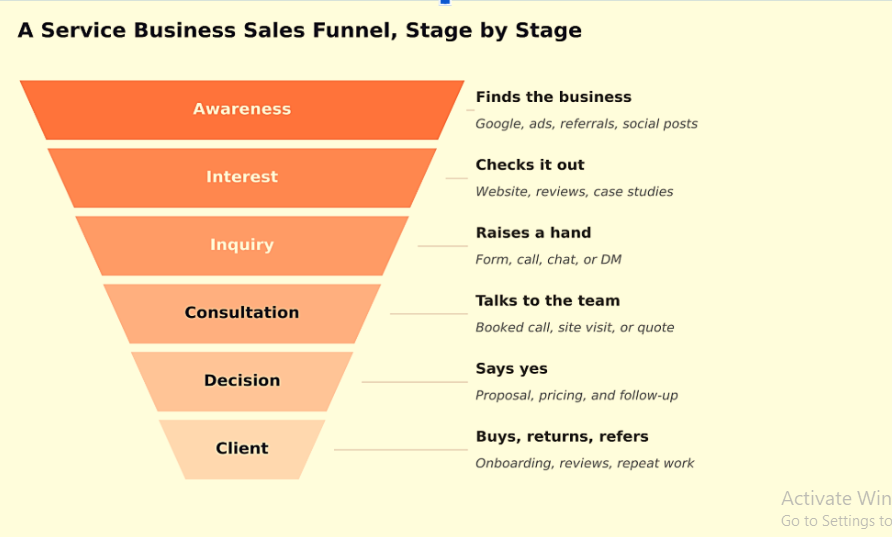
| Six stages | Awareness, interest, inquiry, consultation, decision, and client |
| How it works | Each stage has one goal and one next step, and fewer people pass each stage |
| Why it matters | Gartner research found B2B buyers spend only 17% of buying time meeting suppliers |
| Reviews | BrightLocal's 2025 survey found only 4% of consumers never read online reviews |
| Service vs product | Service funnels center on a conversation, not a checkout |
| First step | Map how clients find and hire the business today, then fix the weakest stage |
What's a Sales Funnel in Marketing?
A sales funnel is a model of the journey a buyer takes before they purchase. It's drawn as a funnel because many people enter at the top and fewer make it through each stage to the bottom.
In business terms, a sales funnel turns a vague idea, “we need more clients,” into specific questions: how many people find the business, how many inquire, how many book a call, and how many say yes.
Marketing and sales funnels are two halves of the same path. Marketing owns the top, getting attention and interest; sales owns the bottom, turning inquiries into paying clients. In digital marketing, most of the top half now happens online through search, ads, social posts, and the website.
How Does a Sales Funnel Work?
A sales funnel works by giving every stage one clear next step. An ad leads to a page, the page leads to a form, and CRM automation helps connect that inquiry to a call and proposal.
That matters because buyers now do most of the work alone. A Gartner press release from September 2020 noted that B2B buyers spend only 17% of their buying time meeting with potential suppliers, and projected that 80% of B2B sales interactions would happen in digital channels by 2025.
In lead generation, the funnel is what connects marketing spend to revenue. Ads and content fill the top, the website and forms capture interest, and follow-up turns those captured leads into booked consultations.
The Six Stages of a Sales Funnel for a Service Business
Most guides describe sales funnel stages for products sold through a checkout. Service businesses sell through a conversation, so the stages look different.
Top of the funnel: awareness and interest
At the top, the job is to be found and to look credible. A potential client either searches for a solution, sees an ad, or hears a recommendation, then checks the website and reviews.
What builds interest
Specific service pages, real project photos, reviews, and case studies do more here than clever slogans. The visitor is deciding whether this business is worth contacting at all.
Middle of the funnel: inquiry and consultation
This is where interest becomes a conversation. A form, call, or chat turns an anonymous visitor into a named lead, and the consultation turns that lead into a real opportunity.
Why speed matters most here
A lead who inquires with three businesses usually books with the first one that replies. The gap between inquiry and consultation is where most service funnels lose the largest number of good leads.
Bottom of the funnel: decision and client
The decision stage covers proposals, quotes, pricing, and follow-up until the client says yes. The client stage is often skipped entirely, even though repeat work and referrals are the cheapest new business available.
The stage most service funnels forget
A short review request and a check-in a few months after the job turns one sale into a source of future leads, which feeds the top of the funnel at no ad cost.
| Stage | Service business example | Main tool | Goal |
|---|---|---|---|
| Awareness | Homeowner searches “roof repair near me” | Google Business Profile, ads | Get found |
| Interest | Reads service page and reviews | Website, reviews, case studies | Earn trust |
| Inquiry | Fills a quote form or calls | Form, phone, chat | Capture contact details |
| Consultation | Site visit or discovery call | Calendar booking, CRM | Understand the job |
| Decision | Receives and reviews a quote | Proposal, follow-up sequence | Win the job |
| Client | Job done, asked for a review | Review request, check-ins | Repeat work and referrals |
Why Service Businesses Need a Sales Funnel
Product businesses can sell to a stranger in a single visit. Service businesses usually can't, because the buyer has to trust a person, not just a product. A funnel builds that trust in steps.
- Buyers check before they call: reviews, photos, and service pages decide who gets the inquiry.
- Leads leak between stages: without a defined next step, inquiries wait, quotes go unanswered, and clients forget.
- Revenue becomes predictable: knowing stage-to-stage rates turns “we need more work” into a number of inquiries needed.
- Marketing spend becomes measurable: a funnel shows whether ads produce clients or just clicks.
- Referrals stop being luck: a planned client stage turns happy customers into a steady lead source.
Reviews sit at the center of the interest stage. In BrightLocal's Local Consumer Review Survey 2025, a survey of 1,026 U.S. consumers, only 4% said they never read online reviews, and 42% said they trust reviews as much as personal recommendations.
For owners, a funnel also brings a kind of calm. Instead of wondering where next month's work will come from, they can see how many inquiries are in progress and what each stage needs.
Sales Funnels for Services vs Products
Sales funnel products, such as an online store, are built around a checkout: product page, cart, payment. The goal is to remove every reason to pause before buying.
A service funnel is built around a conversation. The goal of most pages is to get a call, visit, or consultation booked, because the price and scope usually depend on the job.
That changes what to optimize. A product funnel watches cart abandonment; a service funnel watches response time, booked consultations, and how many quotes turn into signed jobs.
How to Create a Sales Funnel for a Small Service Business
Creating a sales funnel for a small business doesn't require complex software. It requires deciding what happens at each stage and making sure it happens every time.
- Map the current path: write down how the last ten clients found the business and what happened before they paid.
- Pick one core offer: build the first funnel around the service that brings in the most profitable work.
- Build one focused page: a service page with a clear promise, proof, and one way to get in touch.
- Make inquiries easy: a short form, a visible phone number, and online booking where possible.
- Automate the reply: every inquiry gets an instant response and a task for a person to follow up.
- Plan the follow-up: decide how and when quotes get chased, and how clients get asked for reviews.
The reply step deserves extra attention, because it decides how many inquiries ever reach a consultation. Funnel Gator's guide to speed-to-lead response times explains why a five-minute reply window changes how many leads convert.
What Is a Sales Funnel Analysis?
A sales funnel analysis looks at how many people pass from each stage to the next, so the business can see where the biggest drop happens.
For a service business, the simplest version needs four numbers each month: website visitors, inquiries, booked consultations, and signed jobs. A lead management system helps teams track inquiries as they move toward booked consultations and closed deals. Dividing each number by the one before it shows which step loses the most people.
Sales Funnel Mistakes Service Businesses Make
Most funnel problems in service businesses come from building too much too early, or leaving out the human steps:
- Copying product funnels: countdown timers and cart tactics feel wrong when the buyer is hiring a person.
- Too many offers at once: a funnel for every service splits effort and confuses visitors.
- No owner for follow-up: automation sends the first reply, but someone still has to call.
- Ignoring past clients: the client stage is left empty, so referrals stay accidental.
Getting a Sales Funnel Built for a Service Business
A simple funnel can be built in-house. Outside help makes sense when the website, booking, and follow-up all need to work together, or when nobody on the team has time to connect them.
Funnel Gator's website and sales funnel services cover funnel strategy, landing pages, lead capture, a CRM pipeline, and follow-up automation, built over four weeks from discovery to launch-ready design.
In our experience, service businesses get the fastest results by building one funnel for their best offer first. One recent example, a tour booking business, got a redesigned site with clearer navigation and structured tour pages, so visitors could find and book a tour without hunting for it.
One limitation: no funnel template fits every service business. The stages stay the same, but the tools, offers, and follow-up timing need to match how that business actually sells.
Who This Guide Is For (and Who It Isn't)
This guide fits owners of small and mid-sized service businesses, such as contractors, clinics, consultants, and agencies, who get leads but can't predict how many will turn into clients.
It's less useful for online stores selling low-cost products through a checkout, where product funnels and cart optimization matter more than consultations and follow-up.
Final Verdict: A Sales Funnel Makes Growth Something to Plan
A sales funnel is the planned path from first contact to paying client, and for a service business it runs through six stages: awareness, interest, inquiry, consultation, decision, and client. Service businesses need one because buyers research, read reviews, and compare options before they ever call, and every unplanned step between those moments is a chance to lose them. Start by mapping how clients find and hire the business today, build one funnel around the best offer, reply to every inquiry fast, and plan the client stage so referrals stop being luck.
Funnel Gator builds sales funnels for service businesses, from the first landing page to the follow-up that books the call.
FAQs
What's a sales funnel?
A sales funnel is the path a potential client follows from first hearing about a business to paying it, divided into stages. Fewer people pass each stage, which is why it's drawn as a funnel.
What are the stages of a sales funnel?
For a service business, the six stages are awareness, interest, inquiry, consultation, decision, and client. Product businesses often use fewer stages because they sell through a checkout instead of a conversation.
How does a sales funnel work?
Each stage has one goal and one clear next step, such as a page leading to a form and a form leading to a call. Tracking how many people pass each stage shows where the funnel loses the most potential clients.
What is a sales funnel for a small business?
It is a simple, planned path that turns website visitors and referrals into inquiries, booked calls, and paying clients. Most small businesses can start with one service page, a short form, instant replies, and a follow-up plan.
How do you create a sales funnel?
Map how current clients found and hired the business, pick one core offer, build a focused page, and connect fast follow-up to every inquiry. Adding a review request at the end turns past clients into new leads.