
Quick Answer: High-traffic websites fail to convert when visitors arrive with no clear next step, a slow or confusing page, or no follow-up after they leave. Funnel conversion fixes this by turning a website into a sequence of stages, each with one job and one measurable action, so the business can see exactly where visitors drop off and fix that stage first.
The analytics look healthy. Thousands of visitors a month, a rising line in the traffic report, and a marketing team that can point to steady growth.
The revenue line doesn't match. Contact forms trickle in, the phone barely rings, and most visitors read a page or two and leave without doing anything.
Buying more traffic only makes that gap more expensive. The problem usually isn't how many people arrive; it's what happens to them after they do.
This guide explains why high-traffic sites still fail to convert, the stages of a conversion funnel, how to calculate and analyze funnel conversion rate, and how to grow revenue from the traffic a business already has.
| Quick Summary: Funnel Conversion Explained | |
|---|---|
| What a funnel is | A planned path from first visit to paying customer, with one goal per stage |
| Typical benchmark | Unbounce's Q4 2024 data puts the median landing page conversion rate at 6.6% |
| Common leaks | Mismatched traffic, slow pages, unclear offers, and no follow-up |
| Page speed | Google found bounce probability rises 32% as mobile load time goes from 1 to 3 seconds |
| Revenue lever | A 44% gain at three stages roughly triples revenue from the same traffic |
| Stages | Visit, engage, convert, follow-up, and customer |
| First fix | The stage with the biggest drop-off, not the one that looks worst |
What's a Funnel? Funnel Conversion in Marketing Explained
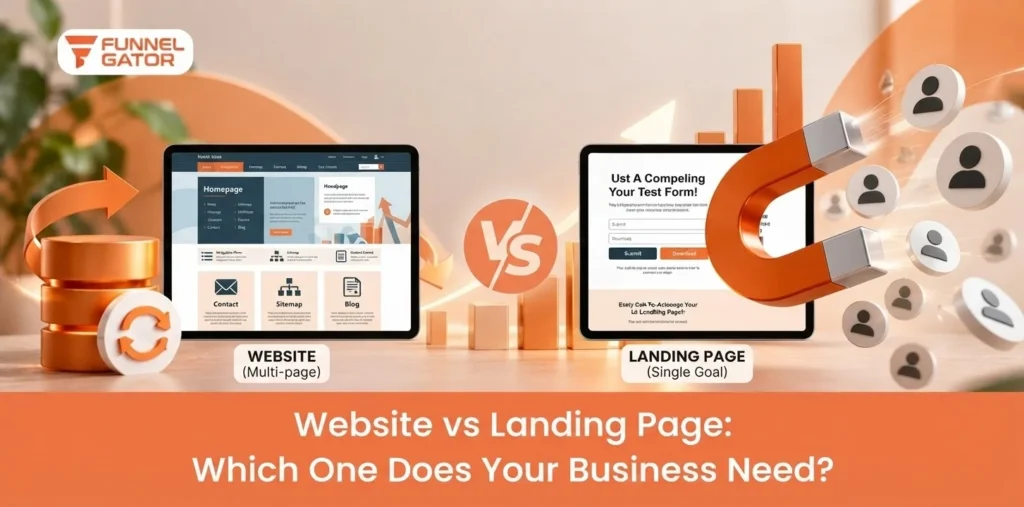
A funnel is the planned path a visitor takes from first contact to becoming a customer. It's called a funnel because fewer people make it through each stage, and the goal is to lose as few as possible along the way. Funnel conversion in marketing is the share of people who move from one stage to the next. A website is just a collection of pages; a funnel is those pages arranged so each one leads to a single next step. A conversion funnel in digital marketing usually starts with lead generation through an ad, search result, or social post, moves through a landing page and an offer, and ends with a form, booking, or purchase, followed by the follow-up that turns that action into revenue.Why High-Traffic Websites Still Fail to Convert
High traffic and low conversion almost always trace back to one of six leaks:- The wrong visitors: traffic from broad keywords or curiosity posts that never had buying intent.
- No single next step: pages that offer five links, three buttons, and no obvious action.
- Slow pages: Google's 2018 mobile page speed benchmarks found bounce probability rises 32% as load time goes from one second to three.
- Confusing copy: jargon and long sentences that make visitors work too hard to understand the offer.
- Missing trust: no reviews, case studies, or clear pricing signals near the decision point.
- No follow-up: visitors who leave once are never seen again because nothing brings them back.
Conversion Funnel Stages and Where Visitors Drop Off
Every funnel conversion process moves through the same five stages, whether the goal is a sale, a booked call, or a form fill. Each stage needs its own metric, because each one leaks for a different reason.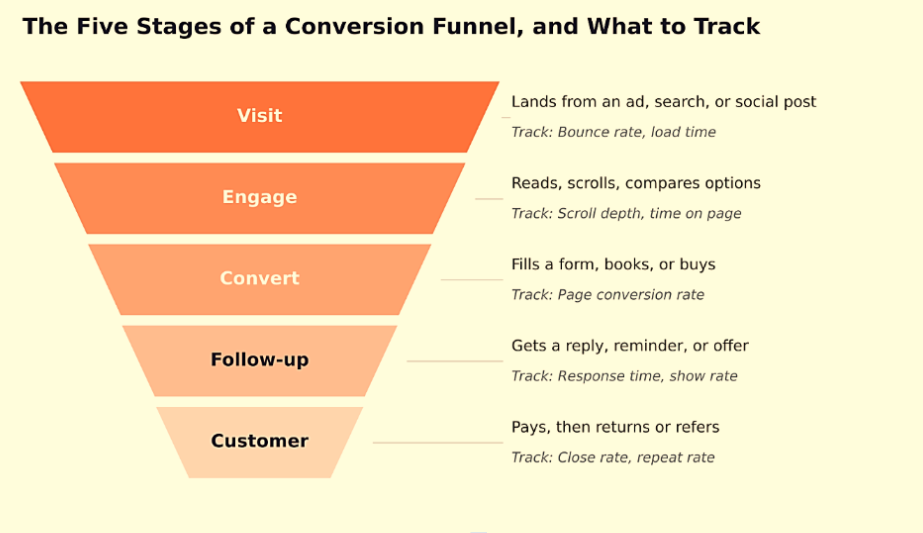
Top of the funnel: visit and engage
The first two stages decide whether a visitor stays long enough to consider the offer. Most drop-off here comes from a mismatch between what the ad or search result promised and what the page shows.Message match
The headline should repeat the promise that brought the visitor in. Someone who clicked an ad for “same-week roof repair” should land on a page about same-week roof repair, not a general homepage.Bottom of the funnel: convert, follow up, and close
The last three stages turn interest into revenue. A page can convert well and still lose the sale if nobody replies to the form for two days.The follow-up stage most funnels forget
Most conversion funnel diagrams end at the form. For service businesses, that's where the real drop-off begins, making speed-to-lead automation important because a lead that waits for a reply often books with whoever answered first.Where to look first
Compare the drop-off between each pair of stages, not the conversion rate of the whole site. The biggest single drop is almost always the cheapest place to win back revenue.| Stage | What the visitor needs | Metric to watch | Common leak |
|---|---|---|---|
| Visit | Proof they landed in the right place | Bounce rate, load time | Ad promise doesn't match the page |
| Engage | A clear reason to keep reading | Scroll depth, time on page | Generic copy and no specifics |
| Convert | One obvious, low-effort action | Page conversion rate | Long forms, too many choices |
| Follow-up | A fast, personal reply | Response time, show rate | Leads waiting hours or days |
| Customer | A reason to buy again or refer | Close rate, repeat rate | No post-sale contact |
How to Calculate Funnel Conversion Rate
Funnel conversion rate is the number of people who complete a stage divided by the number who entered it, multiplied by 100. If 2,000 people view a landing page and 120 submit the form, that stage converts at 6%. The overall funnel conversion rate multiplies every stage together, which is why a small leak early in the funnel shrinks everything after it. For a benchmark, Unbounce's landing page benchmarks put the median conversion rate across all industries at 6.6%, based on 41,000 landing pages and 57 million conversions analyzed in Q4 2024. Benchmarks are a reference point, not a target. A page converting at 3% that sends highly qualified leads into a well-managed B2B sales pipeline can be worth more than one converting at 12% that sends people who never buy.Getting Traffic but Not Enough Leads? Book a Free Strategy Call
Funnel Gator will review the current website and show which funnel stage is losing the most revenue.- A stage-by-stage review of where visitors drop off
- A prioritized list of fixes for pages, forms, and follow-up
- A four-week plan to rebuild the funnel if it needs one
 ▸ SCHEDULE FREE STRATEGY CALL
Conversion Funnel Analysis: How to Find the Leak
A conversion funnel analysis follows the same steps for any business:- Define the stages: write down every step from first visit to paid customer.
- Track each stage: set up analytics events for page views, form starts, submissions, bookings, and sales.
- Find the biggest drop: compare stage-to-stage rates and rank them by lost volume.
- Watch real sessions: session recordings and heatmaps show why people leave, not just that they did.
- Test one change at a time: fix the biggest leak, measure for two to four weeks, then move to the next.
Pro Tip: Track form starts separately from form submissions. A big gap between the two points straight at the form itself, usually too many fields or a confusing question.
How to Triple Revenue From the Same Traffic
Revenue from a funnel is visitors multiplied by conversion rate, close rate, and average value. Because the stages multiply, modest gains at each one compound into a large overall jump. The table shows a hypothetical service business. Improving three stages by 44% each roughly triples monthly revenue without a single extra visitor.| Funnel lever | Before | After | Change |
|---|---|---|---|
| Monthly visitors | 10,000 | 10,000 | No change |
| Visitor-to-lead rate | 2.0% | 2.88% | 44% higher |
| Lead-to-customer rate | 20% | 28.8% | 44% higher |
| Average job value | $500 | $720 | 44% higher |
| Monthly revenue | $20,000 | About $59,700 | About 3x |
Key Takeaway: Doubling traffic doubles cost. Improving three funnel stages by under half each can triple revenue while the ad budget stays the same.
How to Make a Sales Funnel That Converts
Building a sales funnel follows a short sequence, and the order matters more than the tools:- Pick one audience and one offer: a funnel that tries to sell everything to everyone converts nobody.
- Build a focused landing page: one headline, one promise, one call to action, and proof near the button.
- Keep the form short: ask only what is needed to reply, and nothing the business can learn later.
- Connect follow-up: every submission should trigger an instant reply and a task for a person.
- Measure each stage: track every step so the next improvement is based on data, not guesses.
How to Create a Landing Page for Affiliate Marketing
The same funnel rules apply to affiliate landing pages, with two differences. The page has to pre-sell the product before sending visitors to the merchant, and it needs a clear disclosure of the affiliate relationship. A strong affiliate page leads with the problem the product solves, shows an honest comparison or personal result, and uses one call to action. In the U.S., the FTC's Endorsement Guides, updated in 2023, require material connections such as affiliate commissions to be disclosed clearly and conspicuously.Funnel Mistakes That Waste Good Traffic
Some fixes make conversion worse. These are the ones that show up most often:- Optimizing for clicks, not customers: a higher conversion rate from lower-quality leads can reduce revenue.
- Changing everything at once: a full redesign makes it impossible to know which change helped.
- Ignoring mobile: a page that works on a desktop can fail on a phone.
- Stopping at the form: a funnel without follow-up hands warm leads to faster competitors.
⚠ Warning: Don't judge a funnel test on a few days of data. Small samples swing wildly, and calling a winner early often locks in a change that hurts conversion over time.