
Quick Answer: A website is a multi-page home base that helps people research a business and helps it rank in search. A landing page is a single page built for one offer and one action, usually for paid ads or email. Most service businesses need both: a website for credibility and search, and dedicated landing pages for every paid campaign.
A business launches a Google Ads campaign for one service and sends every click to the homepage. Visitors land on a page about everything the company does, look for the offer they clicked on, and leave.
The opposite mistake happens too. A business builds one slick landing page, calls it a website, and then wonders why nobody finds it in search and why buyers don't trust a company with a single page online.
Both problems come from treating the two as interchangeable. They do different jobs, and choosing the wrong one wastes either ad budget or search visibility.
This guide covers the differences, how each affects SEO and paid ads, a decision path for choosing, and why most service businesses end up needing both.
| Quick Summary: Website vs Landing Page Explained | |
|---|---|
| Website | Many pages, many goals: credibility, research, search visibility |
| Landing page | One page, one offer, one action, usually for paid traffic |
| Attention span | Nielsen Norman Group reported in 2011 that users often leave pages within 10 to 20 seconds |
| Google Ads | Landing page experience is one of the three components of Quality Score |
| SEO | Websites build rankings over time; most campaign landing pages aren't built to rank |
| Service businesses | Usually need both: a website as the base and landing pages for campaigns |
| Biggest mistake | Sending paid ad traffic to the homepage |
What's the Difference Between a Website and a Landing Page?
A website is a collection of linked pages under one domain. It explains who the business is, what it offers, who it has helped, and how to get in touch, and it serves visitors with very different questions. A landing page is a single page with one purpose. It usually has no main navigation, focuses on one offer, and asks visitors to take one action, such as booking a call or requesting a quote.| Factor | Website | Landing page |
|---|---|---|
| Purpose | Inform, build trust, rank in search | Convert one audience on one offer |
| Pages | Many linked pages | One focused page |
| Navigation | Full menu and footer links | Minimal or none |
| Main traffic | Search, referrals, direct visits | Paid ads, email, social campaigns |
| Call to action | Several, depending on the page | One |
| Lifespan | Permanent, updated over time | Often tied to a campaign or season |
| Success metric | Organic traffic, inquiries, trust | Conversion rate and cost per lead |
Landing Page vs Homepage: Why the Homepage Isn't Enough
A homepage is the front door to the whole website. It has to serve new prospects, past clients, job seekers, and partners, so it points in many directions at once. That works for general visitors but fails for ad traffic, where attention is short. In a 2011 Nielsen Norman Group analysis of Microsoft Research data covering more than two billion page visits, Jakob Nielsen reported that users often leave web pages within 10 to 20 seconds. The same analysis found that pages which make their value clear in those first seconds can hold attention much longer. A visitor who clicked an ad for one service needs to see that service immediately. A landing page does that; a homepage usually makes them search for it.Website vs Landing Page: Which One Does a Business Need? A Decision Framework
The right choice depends on two questions: do buyers research the business before contacting it, and is there paid traffic or a campaign built around one offer?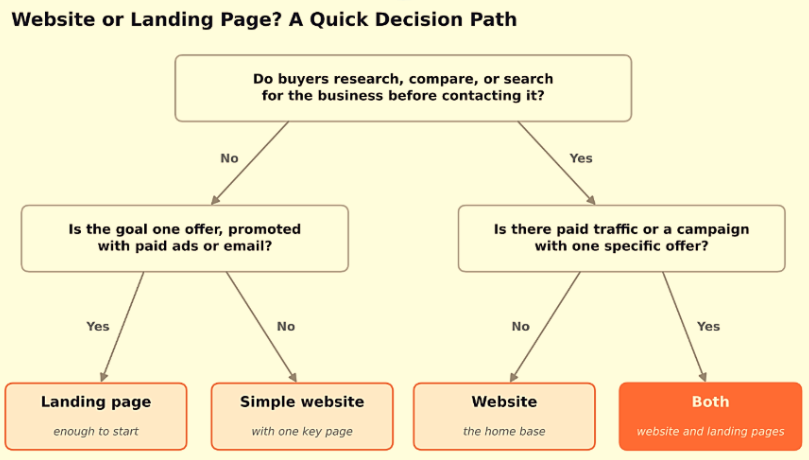
When a landing page is enough
A standalone landing page can carry a business for a while when the sales path is short and the traffic is controlled.Testing an offer before investing more
A new service, workshop, or product can be tested with one landing page and a small ad budget before committing to a full website build.Single-offer businesses with paid traffic
A business selling one clear offer, mostly through ads or email, may get more from one strong page than from a site visitors have to explore.When a website is necessary
A website becomes necessary as soon as buyers want to check the business out, compare options, or find it through search.Research-heavy and local service buyers
People hiring a contractor, clinic, or agency usually look for service pages, reviews, past work, and an About page before they reach out. One page rarely answers all of that.More than one service or audience
A business offering several services needs a page for each, so buyers can find what they need and each service can rank for its own search terms.Why Most Service Businesses Need Both
For most service businesses, the answer isn't one or the other. The website is the permanent base that earns trust and search traffic, and landing pages are the focused entry points for each paid lead generation campaign. The two support each other. A visitor who arrives on a landing page and wants more proof can check the main site, and campaign data from landing pages shows which services and messages deserve more space on the website. Funnel Gator's illumiPure case study shows this setup in practice: a rebuilt main website alongside industry-specific landing pages, with forms and bookings routed straight to the team, and an 86% rise in search impressions over four months without paid ads.Key Takeaway: The website earns trust and search visibility over time; landing pages turn paid clicks into leads now. A service business that runs ads without both is paying for one of those jobs to go undone.
Getting the Right Setup Built for Website and Landing Pages
Some businesses only need a set of landing pages added to a site that already works. Others need the website rebuilt first, because no landing page can fix a main site that doesn't earn trust. Funnel Gator's website and funnel design services cover both: site structure, service pages, campaign landing pages, and lead capture connected to the CRM, built over a four-week process from discovery to launch-ready design. In our experience, the best results come from planning the website and landing pages together, supported by CRM automation that helps capture and follow up with leads, so every campaign has a page to land on and every inquiry has a clear next step. Timelines differ too. A single landing page for an existing offer can often go live within days, while a website with several service pages, case studies, and booking takes weeks, because each page needs its own copy, proof, and testing. One limitation: no rule of thumb says how many landing pages a business needs. The right number is one per distinct offer or ad group that sends meaningful traffic. For owners juggling ads, a website, and day-to-day work, this decision can feel bigger than it is. Getting the structure right once makes every future campaign easier to launch.Not Sure Whether to Build a Website or a Landing Page First? Book a Free Strategy Call
Funnel Gator will review the current website and ad setup and show which pages to build first.- A review of where current ad and search traffic lands
- A recommendation on website pages, landing pages, or both
- A four-week build plan with deliverables listed upfront
 ▸ SCHEDULE FREE STRATEGY CALL
How Landing Pages Affect Google Ads Results
Google uses landing page experience as one of three components of Quality Score, alongside expected click-through rate and ad relevance. Google describes it as how relevant and useful a landing page is to people who click the ad. Google also notes that Quality Score is a diagnostic tool, not a direct input in the ad auction. Its value is in showing where ads and pages fall short, and a low landing page experience rating usually means the page doesn't match what the ad promised. The fix is simple in principle: one ad group, one promise, one matching landing page. A homepage rarely matches a specific ad as closely as a page built for it.SEO Trade-Offs: Websites Rank, Landing Pages Convert
Websites rank because they have depth: many pages covering related topics, internal links between them, and content that earns links from other sites over time. Campaign landing pages usually aren't built to rank. They're short, focused on conversion, and often duplicate content from the main site with small changes for each ad group.- Keep landing pages on the main domain: a subfolder like /lp/ keeps any links and signals on the business's own site.
- Exclude near-duplicate campaign pages from search: a noindex tag stops several similar pages from competing with the main service page.
- Let service pages do the ranking: write one strong, indexable page per service, and use landing pages for paid traffic.
What a Landing Page Needs to Do Its Job
A landing page only beats a homepage if it's built for one job. The essentials are a headline that repeats the ad's promise, proof near the call to action, a short form, and nothing that pulls attention elsewhere. The layout and form decisions behind that are covered in Funnel Gator's breakdown of frictionless B2B landing page architecture, including how to remove friction between the first scroll and the submit button.Pro Tip: Before building anything new, check where current ad clicks land. If every campaign points to the homepage, a set of matching landing pages is usually the fastest fix available.
Website vs Landing Page: Common Mistakes When Choosing Between the Two
These mistakes waste budget whichever option a business picks:- Sending ads to the homepage: visitors have to hunt for the offer they clicked on.
- Calling one landing page a website: buyers who want to research find nothing else to check.
- Building landing pages on a separate domain: the main site gains nothing from the traffic or links.
- Forgetting trust basics: no privacy notice, no reviews, and no business details near a form that asks for personal information.
⚠ Warning: Any page that collects names, emails, or phone numbers should link to a privacy policy, and forms that lead to automated texts or calls need clear consent wording under the TCPA.