
The ads are running, the cost per lead looks fine, and the dashboard shows a healthy number of new contacts each week. Sales still says the leads are bad.
Often the leads aren't bad. They were lost somewhere between the ad click and the first real conversation, and each loss had a different cause.
Some causes are old, like forms with too many fields. Others are newer, like follow-up emails that Gmail now filters and texts that carriers now block.
This blog post walks through the ten causes that come up most often, how to spot each one, and the fix that closes it.
| Quick Summary: Common Reasons for Lead Leakage Explained | |
|---|---|
| Top of funnel | Ad and page mismatch, long forms, sources not connected to the CRM |
| Middle of funnel | Slow replies, one-touch follow-up, spam filtering, blocked texts |
| Bottom of funnel | No handoff rule, booking friction, broken tracking |
| Email rule | Since February 2024, Gmail has required senders to keep spam rates below 0.30% |
| Text rule | Since February 2025, unregistered 10DLC business texts are blocked in the U.S. |
| Fastest check | Compare leads reported by each platform with new records in the CRM |
| First fix | Close capture leaks first, so every later fix has all the leads to work with |
10 Common Reasons for Lead Leakage in a Marketing Funnel
Each reason below includes the symptom that gives it away and the fix that closes it. The reasons are grouped by the funnel stage where the leak happens.
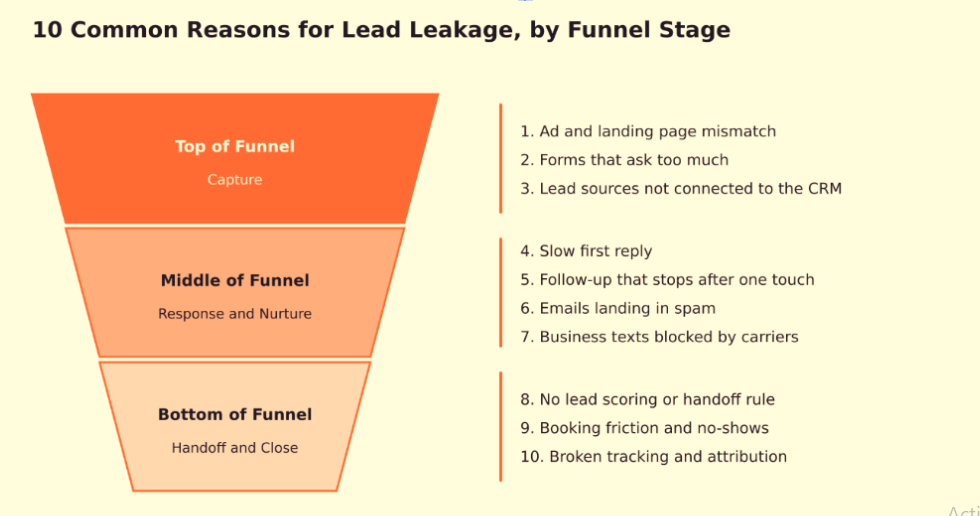
Top of the funnel: capture
Capture leaks happen before a lead becomes a usable record that anyone can act on.
1. The ad promises something the landing page doesn't
A visitor clicks an ad for a free consultation and lands on a generic homepage with five menu options. The promise breaks, and the visitor leaves.
Fix: send each campaign to a page that repeats the ad's offer, headline, and call to action, with one clear next step.
2. Forms ask too much, or break on mobile
Every extra required field is another reason to stop. Forms that load slowly, hide the submit button, or fail validation on phones lose people who had already decided to act.
Fix: ask only for what the first conversation needs, usually a name, a phone number or email, and the service, then test the form on a phone every month.
3. Lead sources aren't connected to the CRM
Meta lead forms, chat widgets, and booking tools often need their own integration. When that integration fails silently, leads pile up where nobody looks.
Fix: use CRM automation to connect every source directly, then send a test lead through each one after any change to the website, a form, or an ad account.
Middle of the funnel: response and nurture
These leaks happen after capture, when the reply is late or the follow-up never reaches the lead.
4. The first reply is too slow
Interest fades quickly after an inquiry. A lead who waits for office hours often contacts the next business on the list and books there instead.
Fix: use speed-to-lead automation to send an automatic text and email within a minute of every inquiry, then alert a named owner to call.
5. Follow-up stops after one touch
One unanswered call or email gets treated as a dead lead. Many common reasons for lead leakage in nurturing come down to this pattern: no sequence, generic messages, and no plan for leads who aren't ready yet.
Fix: build a sequence that mixes calls, texts, and emails over a couple of weeks, stops when the lead replies, and uses database reactivation to reconnect with older leads who have opted in.
6. Follow-up emails land in spam
Since February 2024, Google's email sender guidelines have required every sender to Gmail accounts to set up SPF or DKIM and keep spam rates below 0.30%. Senders of more than 5,000 messages a day must also publish DMARC and support one-click unsubscribe.
A nurture sequence sent from an unauthenticated domain can look healthy in the CRM while many of its messages never reach an inbox.
Fix: authenticate the sending domain, watch spam rates in Google Postmaster Tools, and stop emailing contacts who never open.
7. Business texts are blocked by carriers
Texting is often the fastest way to reach a new lead, but it now depends on registration. According to Telnyx's 10DLC FAQ, unregistered 10DLC traffic in the U.S. has been blocked altogether since February 3, 2025.
10DLC refers to the standard ten-digit local numbers businesses use for texting in the U.S. A missed-call text-back or appointment reminder sent from an unregistered number may simply never arrive.
Why blocked texts go unnoticed
The CRM usually logs the message as sent. Unless someone checks delivery reports, the business assumes leads are ignoring texts they never received.
Fix: register the brand and campaign for A2P 10DLC, collect clear opt-in consent on every form, and review failed deliveries weekly.
Bottom of the funnel: handoff and close
Late leaks waste the most effort, because the lead was already close to buying.
8. There is no lead scoring or handoff rule
When every lead lands in the same list, a ready-to-buy quote request waits behind a newsletter signup. Sales stops trusting marketing leads, and the hot ones go cold.
Fix: define what makes a lead sales-ready, such as a quote request or booked call, and route those leads to a person immediately.
9. Booking takes too many steps, and no-shows go unchased
A lead who agrees to a call, then gets a link, an account sign-up, and no reminder, often never shows up.
Fix: offer booking directly on the page or by text, use appointment reminder automation for confirmations and reminders, and follow up on every no-show the same day.
10. Tracking and attribution are broken
When UTM tags drop off, calls aren't tracked, or the CRM records every lead as direct traffic, budgets move to the wrong channels. The leak here is not one lost lead but lost knowledge of which sources work.
Fix: use call tracking numbers, keep UTM parameters on every ad link, and save the original source on each CRM record.
Funnel Gator’s lead management services close these follow-up leaks at the source, bringing forms, calls, chat, and DMs into one CRM and routing each lead to the right person instantly. The four-week process covers a lead audit, lead mapping, system setup, and optimization, with missed-call text-back and reactivation of older leads built in.
Lead Leakage Reasons, Symptoms, and Fixes at a Glance
The table below condenses all ten reasons into a checklist a marketing or sales manager can review in one sitting.
| Reason | Symptom | Quick check | Fix |
|---|---|---|---|
| 1. Ad and page mismatch | High bounce on paid traffic | Click the ad, read the page | Dedicated page per offer |
| 2. Long or broken forms | Many form starts, few submits | Submit the form on a phone | Fewer required fields |
| 3. Unconnected sources | Platform leads exceed CRM leads | Send a test lead per source | Direct integrations |
| 4. Slow first reply | Leads say they went elsewhere | Time to first reply report | Instant text and email |
| 5. One-touch follow-up | One attempt per lead on record | Touches per lead report | Multi-step sequence |
| 6. Emails in spam | Low opens, high spam rate | Google Postmaster Tools | SPF, DKIM, and DMARC |
| 7. Blocked texts | Texts sent, no replies | Carrier delivery reports | A2P 10DLC registration |
| 8. No handoff rule | Hot leads wait in a general list | Age of quote requests | Sales-ready routing |
| 9. Booking friction | Low show rate | Count steps to book | Direct booking, reminders |
| 10. Broken tracking | Most leads marked direct | Check source fields in the CRM | Call tracking and UTMs |
How to Tell Which Reason Is Costing the Most
Most funnels have more than one leak, but the losses are rarely equal. Finding the largest one first keeps the team from fixing problems that barely matter.
Each kind of gap points to a different group of reasons:
- Platform counts higher than CRM records: reasons 1 to 3.
- Long reply times or few touches per lead: reasons 4 and 5.
- Low email opens or failed text deliveries: reasons 6 and 7.
- Plenty of leads but few kept appointments: reasons 8 and 9.
- Most leads credited to direct traffic: reason 10.
Fixing Front-of-Funnel Leaks: Landing Pages and Forms
Reasons 1 to 3 usually live on the website, not in the sales team. They are fixed by rebuilding the path from ad click to CRM record, not by asking sales to work harder.
Funnel Gator's website and funnel design services cover campaign landing pages, lead capture forms connected to the CRM, pixel tracking, and conversion testing, delivered through a four-week process from discovery to visual design.
In our builds, every form is submitted from a phone before launch, and the test lead is traced all the way into the CRM pipeline.
Fixing Follow-Up Leaks: What to Automate First
Reasons 4, 5, and 9 respond best to automation, because they depend on timing more than judgment. A sensible order is:
- Instant reply: a text and email to every new lead within a minute.
- Owner alert: a notification and call task for a named person.
- Follow-up sequence: several touches across channels that stop when the lead replies.
- Booking support: appointment booking funnels, confirmations, reminders, and same-day no-show follow-up.
Reasons 6 and 7 come before any of this. Automated messages that never arrive fix nothing, so domain authentication and texting registration should be finished first.
Proof: Closing Follow-Up Leaks at Apex Auto Care
The Apex Auto Care case study shows what happens when the middle-of-funnel leaks are closed. Funnel Gator rebuilt the business's GoHighLevel CRM into nine connected pipelines with automated follow-up.
Speed to lead dropped from four to six hours to about five minutes, and the share of leads going cold fell from about 35% to under 5%. The lead-to-job close rate rose from 22% to 34%, and revenue grew 48%.
Mistakes That Create New Leaks While Fixing Old Ones
Some fixes solve one leak and quietly open another:
- Adding qualifying questions to every form: lead quality may rise, but total leads often fall.
- Sending more messages instead of better ones: higher spam complaints hurt delivery for every future email.
- Texting without opt-in consent: complaints can lead carriers to filter even a registered number.
- Changing everything at once: nobody can tell which fix actually worked.
Final Verdict: Most Leaks Are Process Problems, Not Lead Problems
The common reasons for lead leakage in a marketing funnel fall into three groups. At the top, ads and pages don't match, forms ask too much, and sources never reach the CRM. In the middle, replies are slow, follow-up stops after one touch, and in 2026, emails and texts fail without proper authentication and registration. At the bottom, hot leads have no handoff rule, booking takes too many steps, and broken tracking hides what works. Compare platform counts with CRM records to find the biggest gap, fix capture first, secure email and text delivery next, and only then add more automation or more ad spend.
Find out the Leaks in Your Funnel: Book a Free Strategy Call
Funnel Gator will trace leads from ad click to booked appointment and show which of these ten reasons is costing the most.
- A test lead sent through every form, ad lead form, and phone number
- An email authentication and texting registration check
- A prioritized fix list, starting with the largest leak
No payment, no pressure, just a plan.

FAQs
What are the most common reasons for lead leakage in a marketing funnel?
The most common reasons are mismatched ads and landing pages, long forms, unconnected lead sources, slow replies, and follow-up that stops after one touch. Spam filtering, blocked texts, booking friction, and broken tracking round out the list.
Why do follow-up emails go to spam?
Emails often go to spam when the sending domain lacks SPF, DKIM, or DMARC, or when too many recipients mark them as spam. Google's sender rules require senders to keep spam rates below 0.30%.
Why are business text messages not being delivered?
In the U.S., texts from standard local numbers must be registered for A2P 10DLC, and unregistered traffic is blocked. Missing opt-in consent and high complaint rates can also lead carriers to filter messages.
How do you find where a marketing funnel is leaking?
Compare the leads each platform reports with new CRM records, then check reply times, follow-up touches, deliveries, and bookings. The largest gap shows which reason to fix first.
What should be fixed first to stop lead leakage?
Fix capture leaks first, so every lead reaches the CRM, then secure email and text delivery. Automation and extra ad spend work better once those foundations are in place.
Who This Guide Is For (and Who It Isn't)
This guide fits marketers and owners at service businesses and clinics who run paid ads or SEO, generate a steady flow of leads, and suspect too few of them turn into booked customers.
It's less useful for businesses that sell entirely through marketplaces or retail partners, where the platform controls the lead and the follow-up.