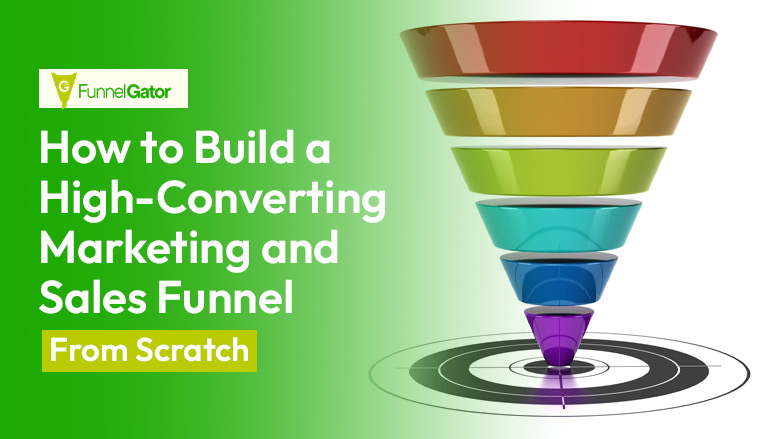
How to Build a High-Converting Marketing and Sales Funnel from Scratch
In today’s digital landscape, attention alone isn’t enough. Businesses can pour thousands into ads or content, but without a system that turns that attention into customers, it all leaks away. That’s why building a high-converting marketing and sales funnel is no longer optional — it’s the foundation of predictable growth.
A marketing and sales funnels are more than a diagram; it’s the structured journey that transforms strangers into paying customers and loyal advocates. Whether you are a small business owner, marketer, or SaaS founder, this step-by-step guide will show you exactly how to create a sales funnel from scratch that converts, scales, and works even while you sleep.
What Is Sales Funnel in Digital Marketing?
A sales funnel in online marketing is the entire process a customer undergoes - finding out about your brand to buying and coming back. Think of it as a funnel: broad on the top to draw attention and small at the bottom where purchasing decisions are made.
Marketing funnel drives awareness and interactions whereas sales funnel builder seals the deal. They all make up one complete system that captures, nurtures, and converts leads.
Why Every Business Needs One
The sales funnel marketing Chaos can only be organized by a funnel. It helps you:
• Know the flow of leads through the customer journey.
• Determine the points of leakage among the potential buyers.
• Auto-nurture and customized messages.
• Monitor performance in real-time.
Concisely, marketing and sales funnel is the driving force behind steady conversions and sustainable growth.
How to Create a High Converting Sales Funnel from Scratch: A Quick Steps
Building your high converting sales funnels isn’t about tools first — it’s about structure, psychology, and flow. Follow these five steps to create a system that runs smoothly from day one.
Step 1: Define Your Ideal Customer Avatar
Start with clarity. Who are you trying to reach?
Identify demographics (age, role, location).
Understand pain points and motivations.
Ask: “What problem keeps them up at night?”
Use surveys, analytics, or CRM insights to create two or three detailed buyer personas. When you know exactly who your audience is, your funnel messaging feels tailor-made — and conversions follow naturally.
Step 2: Map Out Your Funnel Goals
Each stage of your funnel must have a specific objective:

Use visualization tools like Miro, Funnelytics, or Lucidchart to see how leads flow from one stage to the next.
Step 3: Build Conversion Assets — Landing Pages & Lead Magnets
Your funnel’s power comes from conversion assets:
Landing Pages: One goal, one offer, one CTA. Keep it minimal, mobile-friendly, and fast.
Lead Magnets: Offer instant value — a free guide, checklist, or template that solves one problem.
Example headline:
“Get the Free Sales Funnel Template That Helped 500+ Businesses Boost Conversions by 40%.”
Tools like ClickFunnels, Unbounce, or Perspective make building these pages easy, even without coding.
Step 4: Automate Lead Nurturing
Automation turns your funnel into an evergreen sales funnel that works around the clock.
Use ActiveCampaign, HubSpot, or MailerLite to:
Send follow-up emails based on user behavior.
Segment lists by interest or engagement.
Trigger reminders for cart abandoners.
Example workflow:
A visitor downloads your guide.
They automatically receive a 5-email sequence with quick wins.
The final email offers a free trial or consultation.
Automation keeps your leads warm and your brand consistent — even when you’re not manually following up, especially with intelligent AI voice agents.
Step 5: Test, Measure, and Optimize
A funnel isn’t static; it’s a living system that improves through testing.
Use VWO, Hotjar, or Google Optimize to analyze:
Page performance through heat maps and click tracking.
Conversion rates across stages.
Email open and click-through rates.
A/B test elements like headlines, CTAs, colors, and pricing. Each small improvement compounds into higher overall ROI.
That’s how you create a high-converting modern sales funnel that evolves alongside your audience — especially when you implement strategic funnel automation.
The 5 Stages of Sales Funnel for High-Converting Marketing
All effective funnel stages in sales that lead the potential customers. Knowing these will assist you in planning the content and automation at every stage of the buyer journey.
1. Awareness (Top of the Funnel — TOFU)
This is the place where your brand is known to new audiences. Attention should be attracted with the help of SEO-optimized blog posts, social media campaigns, and paid ads.
Goal: Create awareness and reach the right audience.
Scenario: To attract organic traffic, a digital agency writes 10 Proven Ways to Increase Website Conversions.
2. Interest (Middle of the Funnel — MOFU)
Here, leads begin exploring your solutions. Offer free value that positions your brand as a helpful expert.
Tactics: Ebooks, webinars, short courses, or newsletters.
Goal: Build trust and engagement.
3. Consideration
Now prospects are comparing options. Use content that proves your credibility — case studies, success stories, and product demos.
Goal: Educate and reduce uncertainty.
4. Conversion (Bottom of the Funnel — BOFU)
This is the decision stage. Simplify purchasing with clear CTAs, limited-time offers, and free trials.
Goal: Turn prospects into paying customers.
5. Retention and Loyalty
After the sale, nurture customers with onboarding, loyalty programs, and re-engagement campaigns.
Goal: Encourage repeat business and referrals.
Scenario:A visual funnel chart here can illustrate how traffic narrows and intensifies through each stage — from awareness at the top to loyalty at the bottom.
Best Practices for High Converting Funnels and Advanced Strategies.
After you have your core funnel established, these are some of the advanced strategies that can be used to multiply results.
1. Personalize Every Step
Personalize your messages using user information:
• Present moving landing pages with regard to location or activity.
• Personalize email subject lines to interest of the user.
• Suggest products or resources depending on the browsing.
This is made easy by tools such as Segment, Convert Flow and VWO Personalize.
2. Conduct Multi-Channel Remarketing Campaigns.
Don’t stop at email. Re-target prospects in places that they already frequent:
•Google Display Ads to recover awareness.
•Instagram retargeting and Facebook retargeting.
•B2B campaigns on LinkedIn.
Having a unified message in all channels keeps your brand on the mind of your prospect until he / she is ready to buy.
3. Use Social Proof to Build Trust
Trust converts faster than features. Add:
Customer testimonials and star ratings.
Case studies that show measurable outcomes.
Money-back guarantees or trial periods.
These remove hesitations and make saying “yes” the easy choice.
4. Create Urgency and Scarcity
Encourage timely action through:
Countdown timers.
Limited-time discounts.
Bonus offers that expire soon.
These psychological triggers consistently boost conversion rates without added ad spend if you are planning to build a sales funnel.
5. Add Retention Loops
Your current customers are your best future revenue.
Automate thank-you emails and referral rewards.
Offer loyalty discounts or member-only deals.
Encourage reviews and testimonials.
Retention funnels turn one-time buyers into repeat advocates — the most profitable audience segment you will ever have.
Make a High Converting Sales Funnel with Funnel Gator.
You Don't need to spend weeks assembling tools together when you can create, automate and roll out your complete funnel all under one roof. Funnel Gator gives you all you need to capture, nurture and convert leads at an accelerated rate all in a single dashboard.
Effective and Reliable Process to Start with:
Drag-and-drop funnel builder: Build landing pages, lead magnets, and checkout flows in minutes.
Inbuilt automation: Auto-sending of personalized emails, follow-ups and SMS campaigns.
Live analytics: Monitor CTR, conversions, CAC and LTV.
Scaling integrations: Build your CRM, ad accounts, and payment gateways with ease.
Funnel Gator allows you to turn clicks into customers, whether you are a marketer, agency, or a small-business owner and without the headache of technology.
Get your free trial of 14 days at funnel-gator and see your funnel turn into conversion machine.
Funnel-Building Tools that Might Help
You can build a high converting sales funnel with or without expensive tools. Here’s your quick tech stack:

Pro tip: Combine Google Forms, Zapier, and Sheets to make a fully functional funnel for sales for free.
Measuring Success — The Metrics That Matter
If you don’t measure it, you can’t improve it. Here’s a visual representation of the key funnel performance metrics, showing benchmark values for CTR, Conversion Rate, CAC, LTV, and Drop-Off Rate. Track these KPIs across your funnel:
Use Looker Studio or your CRM dashboard to visualize results. Monitor weekly and refine constantly, optimization never stops.
Common Funnel Mistakes to Avoid
Even seasoned marketers slip up on the basics during funnel process. Avoid these pitfalls:
1.Too many steps or form fields (friction kills momentum).
2.Ignoring mobile responsiveness.
3.Using weak CTAs like “Learn More” instead of “Start My Free Trial.”
4.Neglecting post-purchase engagement.
5.Not testing pages regularly.
Fixing just one of these can lift conversions by 20% or more. Read more here how to fix funnel mistakes.
Real-World Example: The Evergreen Funnel in Action
Let’s suppose a funnel in sales for SaaS startup offering automation tools implemented this very structure:
Lead Magnet: Free “AI Automation Blueprint” PDF.
Automation: A 7-day email nurture sequence with video tips.
Offer: 14-day free trial with onboarding walkthrough.
Optimization: Weekly A/B testing of landing page headlines after setting up a sales funnel.
Results after 60 days:
38% higher trial sign-ups.
24% lower churn.
3.4× ROI on ad spend.
That’s the compound power of an optimized, automated, and evergreen sales funnel.
Conclusion: Transform Your Funnel into a Revenue Machine.
Creating a sales funnel for marketing does not mean being complex but rather being clear, consistent, and data-driven. Start small. Automate, build one funnel, optimize one step, and follow-up one. As you do it, your conversion rates increase and your costs of acquisition decrease.
A high-converting funnel doesn’t just sell, it scales. Let’s connect with Funnel Gator to show you how!
Ready to launch yours?
Start your 14 free trial today and access templates, automation blueprints, and funnel-building tools that help you attract, nurture, and convert leads faster than ever.
FAQs about Marketing and Sales Funnel
1. What then is the distinction between a sales funnel and a marketing funnel?
Building a sales funnel is aimed at attracting and developing leads with the help of awareness and engagement, whereas a sales funnel directs qualified leads to the purchase. Interest is generated through the marketing funnel; the deal is sealed by the sales funnel. The three collectively constitute a total customer acquisition process.
2. Is Marketing sales funnel a marketing activity?
Yes - Marketing sales funnels are a necessary marketing practice that is compatible with Sales funnel strategy. It amalgamates content marketing, lead nurturing, automation and conversion strategies to transition the prospects between curiosity and commitment.
3. Who needs a sales funnel?
All businesses make a sales funnel aiming at steady leads and conversions require a sale funnel, whether it is a startup, agency, or ecommerce shop, SaaS or service provider. An effective funnel can assist any company with automating growth and scale in a foreseeable manner.
4. In what cases do sales funnels fail?
Sales funnel creation do not work because they are not clearly targeted, are poorly messaged or do not have a follow-up Sales funnel strategies. Some other reasons are poor offers, slow loading, or the inability to monitor performance. The secret is always to optimize using analytics and A/B testing.
5. What is sales funnel leakage?
Sales conversion funnel leakage occurs when leads fall off without doing something we want them to do - such as not buying a cart or not responding to an email. Keeping track of the conversion rate, CTR, and drop-off points allow sealing these leaks and restoring the lost revenue.
6.What is the difference between Sales Funnel Vs Sales Pipeline?
Although the terms are used interchangeably for funnel building, there is one major difference:
• Sales Funnel: This is about the customer experience in terms of awareness, interest, consideration, and purchase.
• Sales Pipeline: Dwelling on the inside process of your team with managing all the prospects, meetings and deals.
By combining the two, marketing will be able to generate qualified leads, and the sales process will be able to convert them into revenue in an efficient manner.


